Titmus Fly Test
It is one of the most widely used tests for measuring stereopsis and detecting retinal disparity.
1. Description of the Device and Instruments
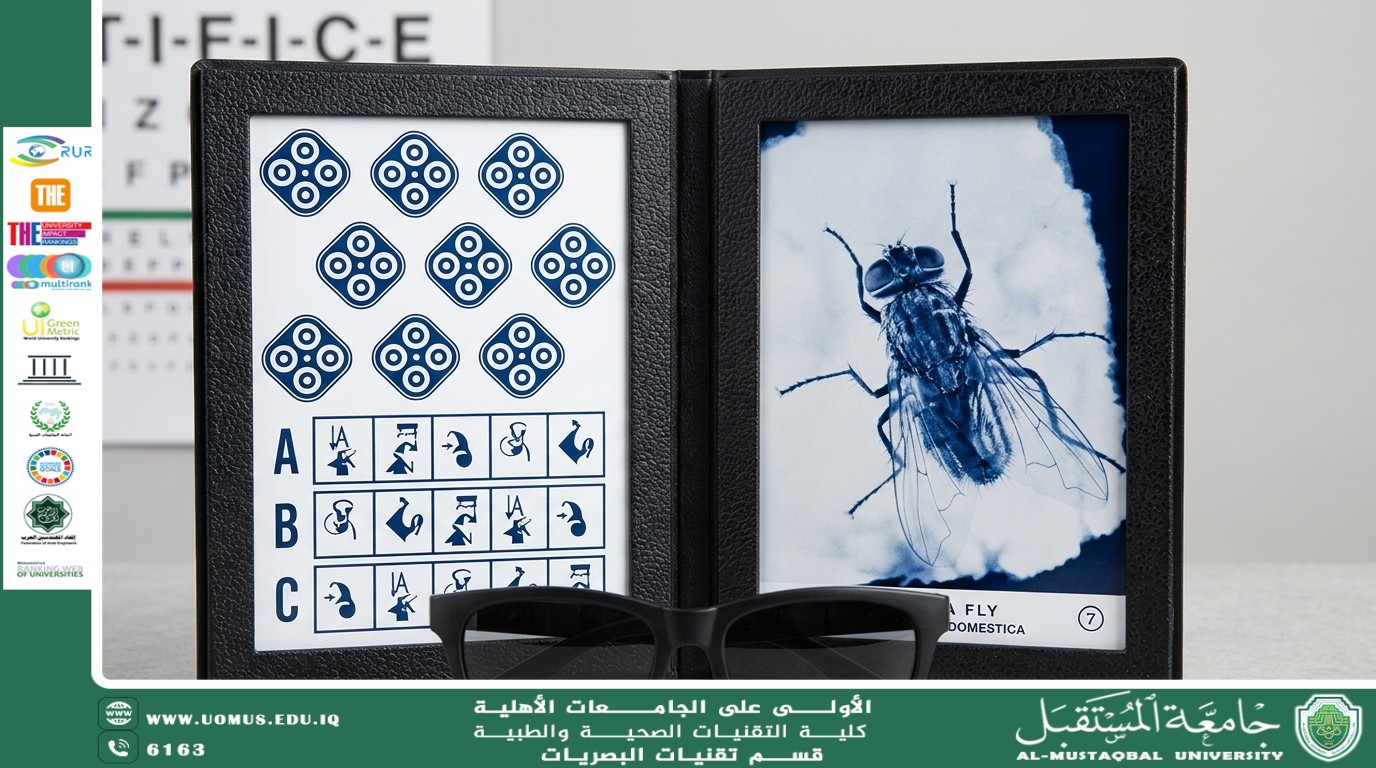
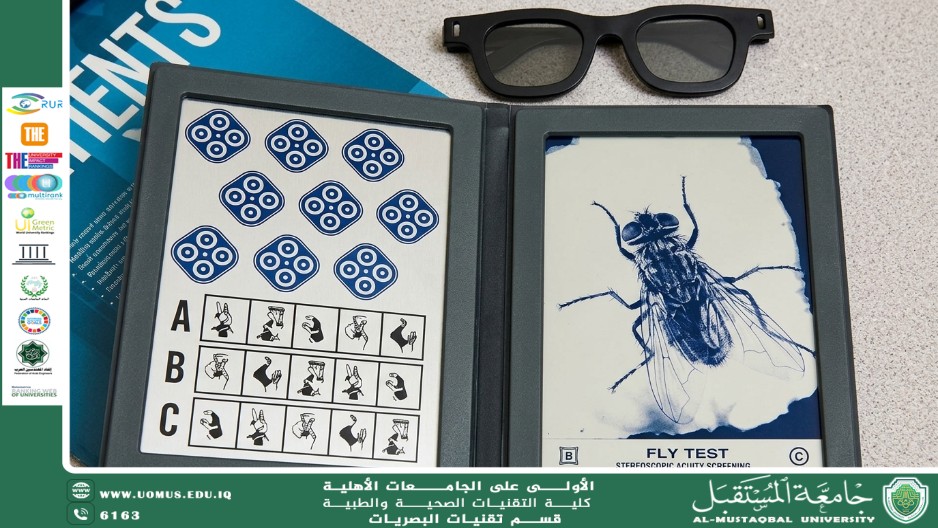
Setup: Consists of two panels in the form of a booklet that opens in front of the patient.
Polarized Glasses: The patient must wear these to view the images in 3D; they separate the images reaching each eye (one reflects light with vertical polarization and the other with horizontal polarization).
2. Components of the Test Pages
The test is divided into three main parts:
The Fly: Located on the right side, it is intended for near vision testing. There are two identical flies with a very slight offset (Retinal Disparity) to create an illusion of depth.
The Wirth Circles: Located on the left side, these consist of 9 slanted squares, each containing 4 circles. Their purpose is to measure stereoscopic visual acuity with precision (from high to low levels).
The Animal Series: Designed for examining children who may have difficulty distinguishing the circles.
3. Test Procedures
The test is conducted at a distance of 40 cm from the patient’s eye.
Ensure that the page is perfectly parallel to the patient’s face.
Fly Test: We ask the patient to try to “catch” the fly’s wing; if they have stereoscopic vision, they will feel that the wing protrudes beyond the page.
Squares Test: We ask the patient to identify the circle that appears to protrude (or “float” above the page) among the four circles in each square.
4. Important Notes for the Examiner
During the test, pay attention to the following:
Head Stability: Do not allow the patient to tilt their head forward, backward, or to the sides, as this distorts the polarization effect.
Type of vision: Ask the patient whether the circle appears clearly defined or whether it appears with a “wobble” or tremor.
Error criterion: The patient’s result is considered acceptable until they make two consecutive errors.
Evaluation: The correct answers are found on the back of the booklet; based on the last box the patient is able to solve, the degree of stereopsis is determined in seconds of arc (Seconds of arc).
Lecturer: Mahiman Samir Aref