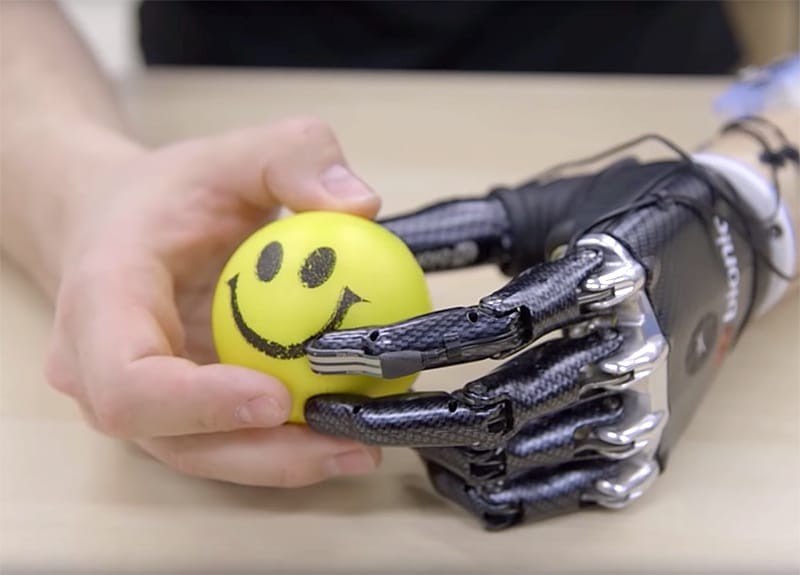
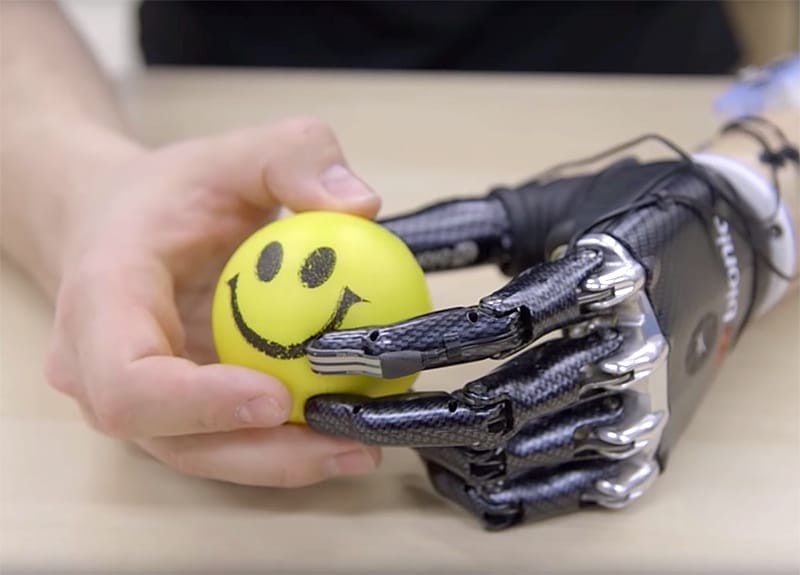
Bionic Prosthetics: When the Human Mind Merges with Machine
Prosthetic engineering has moved beyond simple cosmetic and mechanical replacement, entering a new era known as "Bionics." This pioneering field aims to bridge the gap between the machine and the human nervous system, allowing patients to control their prosthetic limbs simply by thinking, just as they do with their healthy, natural limbs.
The fundamental technology in this advanced field relies on "Myoelectric Prostheses." After an amputation, the nerves that once controlled the missing limb remain alive and capable of transmitting signals from the brain to the residual muscles in the amputated limb. Prosthetic engineers place precise sensors (electrodes) on the skin's surface over these muscles. When the patient thinks about moving their missing hand, the residual muscles contract; the sensors pick up these minute electrical signals, amplify them, and send them to a microprocessor located within the prosthetic limb. The processor translates these signals into motor commands that drive small motors to move the fingers or wrist with precision and smoothness.
To improve this response, a modern surgical and engineering technique known as "Targeted Muscle Reinnervation" (TMR) has emerged. In this delicate procedure, the nerves that were connected to the amputated limb are taken and redirected to other healthy muscles in the body (such as the chest muscles in the case of a shoulder disarticulation). When the patient thinks about moving their arm, the chest muscles contract, creating very strong and clear electrical signals that the prosthetic limb can easily read and decode using artificial intelligence algorithms (Pattern Recognition).
As for lower limbs, "Microprocessor-controlled joints," such as bionic knees and ankles, have revolutionized the lives of amputees. These joints contain sensors that read walking speed, joint angle, and terrain type hundreds of times per second. Based on this data, the processor adjusts the joint's hydraulic or pneumatic resistance in a fraction of a second, preventing the patient from stumbling and providing a natural, safe gait.
The future of bionic limbs is not limited to movement alone but extends to include "Sensory Feedback." Researchers today are working on equipping prosthetic limbs with pressure and temperature sensors, connected directly to the patient's residual nerves. This will allow them to feel the texture of objects and the strength of their grip. We are approaching a day when prosthetic limbs become a true replacement whose functions are indistinguishable from the original human limb.