


Invisible Colors and Their Role in Understanding the World By: Esrar Samandar
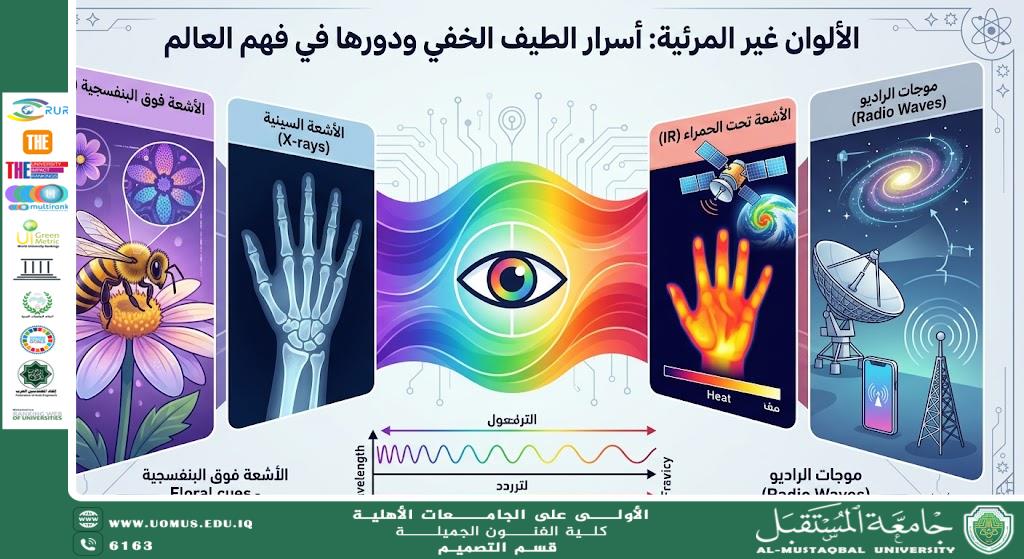
Although our eyes cannot see all colors, the electromagnetic spectrum extends beyond visible light. Ultraviolet (UV) and infrared (IR) rays are prominent examples of these hidden colors. UV rays, which lie beyond the violet end of the spectrum, are used in medicine for skin examination and chemical detection. Infrared rays, on the other hand, are employed in night vision systems, communications, and temperature measurements.
Despite being invisible to us, these colors play a vital role in understanding the world. For instance, ultraviolet rays help scientists study distant stars, while infrared rays allow us to see through fog and dust. Through these technologies, we can uncover hidden worlds and expand the boundaries of our knowledge.
Understanding and utilizing these colors is not limited to natural sciences but extends to technology. They are crucial for communication systems, infrared cameras, and even biometric applications like fingerprint recognition. The hidden world of colors opens a window to an unseen realm that nonetheless impacts everything around us.