Toward Sustainable Poverty Solutions in Iraq Estimating Impact Costs and Building Integrated Response Policies in line with Sustainable Development Goals College of Administrative Sciences Conference
Prepared by Professor Dr. Haider Ali Al-Dulaimi
College of Administrative Sciences
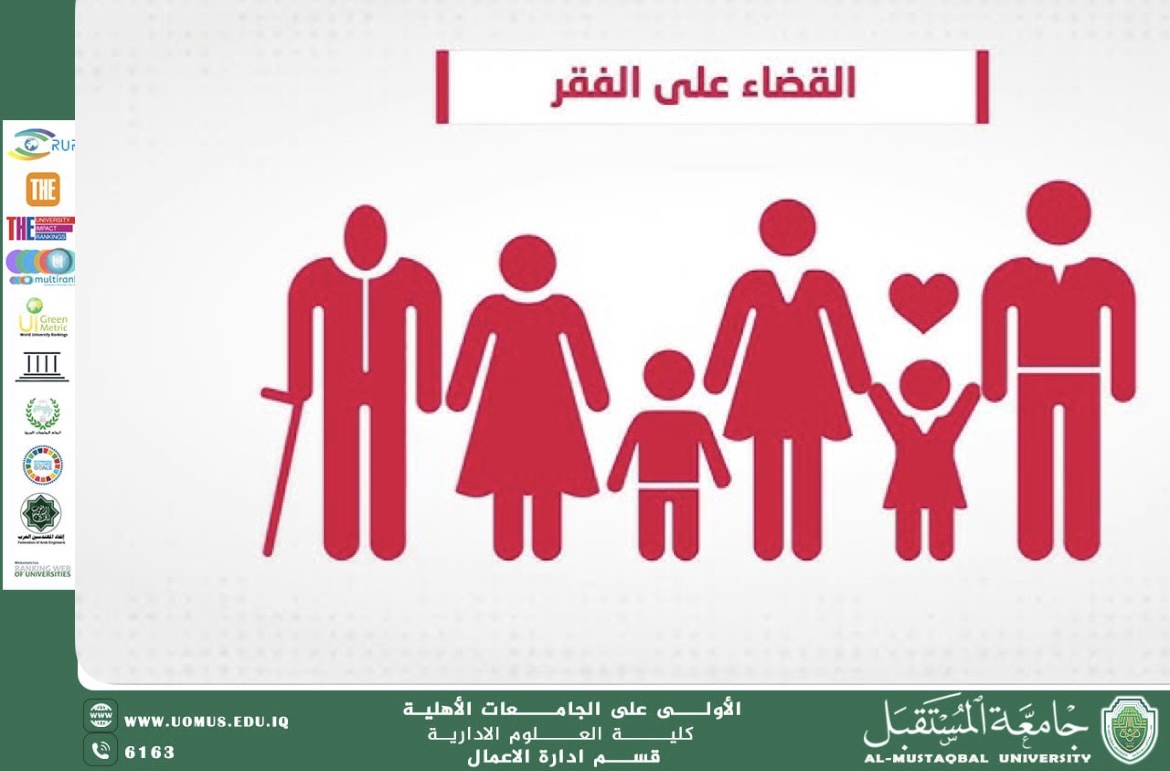
Poverty in Iraq represents one of the most complex and interconnected challenges, as it is not merely an economic phenomenon but also encompasses deep social and developmental dimensions that affect societal stability and the course of comprehensive development. In this context, the College of Administrative Sciences Conference presents a rigorous scientific approach aimed at understanding the true cost of poverty’s impact and building integrated response policies aligned with the Sustainable Development Goals.
Estimating the cost of poverty should not be limited to income levels or unemployment rates alone; rather, it requires a comprehensive analysis that includes declining quality of education, weak healthcare services, rising social vulnerability, and the indirect losses borne by the state due to decreased productivity and increasing financial burdens on public budgets. Accordingly, poverty constitutes a compounded cost that affects human capital and limits the potential for sustainable economic growth.
This vision aligns with the Sustainable Development Goals, particularly Goal 1 (No Poverty), which is closely linked to other goals such as quality education, good health, decent work, and reduced inequalities. Therefore, addressing poverty in Iraq requires the adoption of multidimensional policies that integrate economic, social, and institutional efforts.
Building effective response policies necessitates a shift from short-term remedies to long-term strategies that focus on empowering individuals and enhancing their productive capacities. This includes developing social protection programs, stimulating investment in productive sectors, supporting small and medium enterprises, and improving the quality of education and training in line with labor market needs.
Good governance also represents a fundamental pillar in this framework, as it contributes to efficient resource allocation, reducing waste, and enhancing transparency and accountability, ensuring that support reaches those who deserve it and achieves a real developmental impact. The importance of partnerships between the public and private sectors cannot be overlooked, in addition to the role of academic institutions in providing insights and analyses that contribute to evidence-based policymaking.
In conclusion, the College of Administrative Sciences Conference represents an important scientific platform for exchanging ideas and expertise, and for reshaping development visions in line with current challenges. Moving toward sustainable solutions to poverty in Iraq requires institutional will, strategic planning, and policy integration to achieve comprehensive and equitable development that meets societal aspirations and aligns with the Sustainable Development Goals.