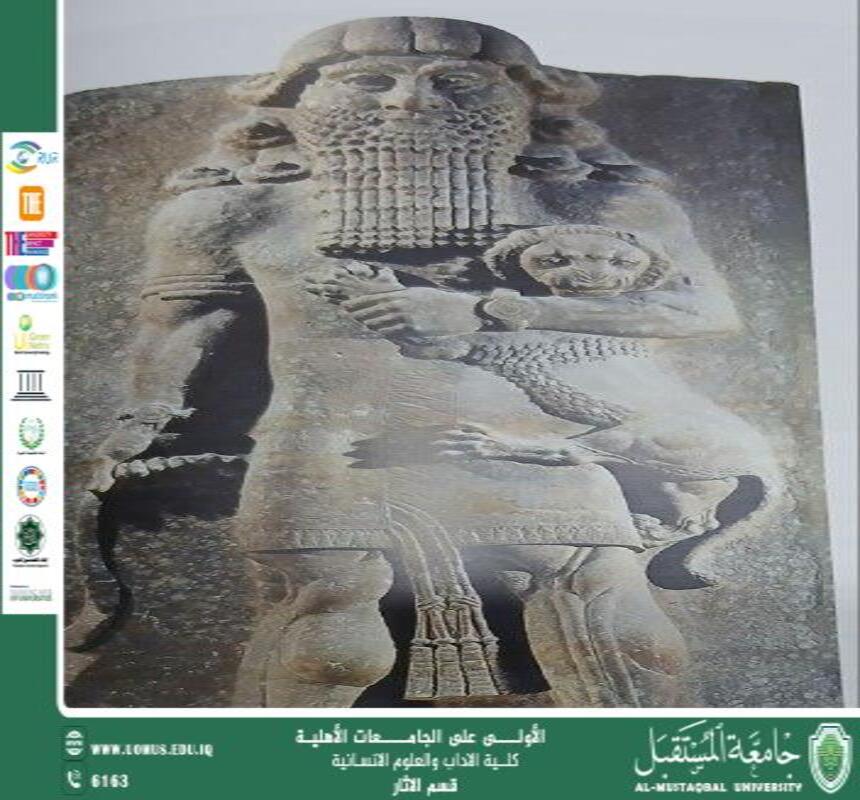
Dr. Mariam Imran Musa from the Department of Archaeology writes a scholarly article titled “Myth: In Linguistic and Terminological Terms.”
Myth: In Linguistic and Terminological Terms<br /><br />This article contributes to the achievement of Sustainable Development Goal 4, which states: "Ensure inclusive and equitable quality education and promote lifelong learning opportunities for all.<br /><br />A myth is considered a universal phenomenon that has accompanied societies, both ancient and modern, so that the heritage of every nation includes it in one way or another; it is an element that exists, in some form, at all stages of civilization and among all known peoples. Myths arise, like everything else, under the primitive conditions that prevailed in ancient times.<br /><br />Mythology is a branch of knowledge devoted to the study and interpretation of myths. The first part of the word is derived from "mytho," meaning a traditional tale about gods and heroes, and the second part, "logy," signifies a field of study, a suffix widely used to denote various sciences. Mythology is concerned with the scientific study of myths, exploring their origins and primary contexts. Initially, the term was used to understand the mythological system of any given dynasty, and later to search for and study the myth itself; it examines the primitive, early form of religion. It also interprets myths and stories related to religion and the early human experience. Thus, modern mythology has focused on defining the myth, studying the stimuli behind its emergence and its interpretation, and examining its psychological, intellectual, and social functions.<br /><br />In the Arabic language, myths have been known as "al-abāṭīl" (falsehoods), i.e., tales that lack order. The word "satr" means a line or row, as in a line of writing, trees, or date palms, and its plural is "asatir" (lines). It has been said "Asatir al-Awail" (the myths of the ancients), meaning those written by the ancients. The word "أسطورة" (usṭūra) itself has come to mean an event or a tale. God said: "Nun, the pen, and what they inscribe," meaning what the angels write; His words were inscribed, and were inscribed on us; and when one comes with narratives resembling falsehood, it is said, "He inscribes what has no basis," i.e., he fabricates. Myths are mentioned several times in the Holy Qur'an; among them is the verse: "And when Our verses are recited to them, they say, 'We have heard, if we wish, we can say something like this.' Truly, these are nothing but the myths of the ancients." It is essential to distinguish a myth from an epic and a fable, as a myth contains mythological elements. An epic is a distinct form of literature in its style and method, recording the feats and heroic deeds of kings and heroes who were exalted to the level of gods, possessing superhuman strength, giant bodies, and famous adventures. Given that the origin of the myth lies in Sumer, the epic also originated in Sumer. As for the fable, it is a tale filled with imagination, exaggeration, and supernatural occurrences, where the main character around whom the fable is woven is, in fact, real and historical.<br /><br />Al‑Mustaqbal University – The Premier University in Iraq.<br/><br/><a href=https://uomus.edu.iq/En/Default.aspx target=_blank>The Official Website of Al‑Mustaqbal University</a>