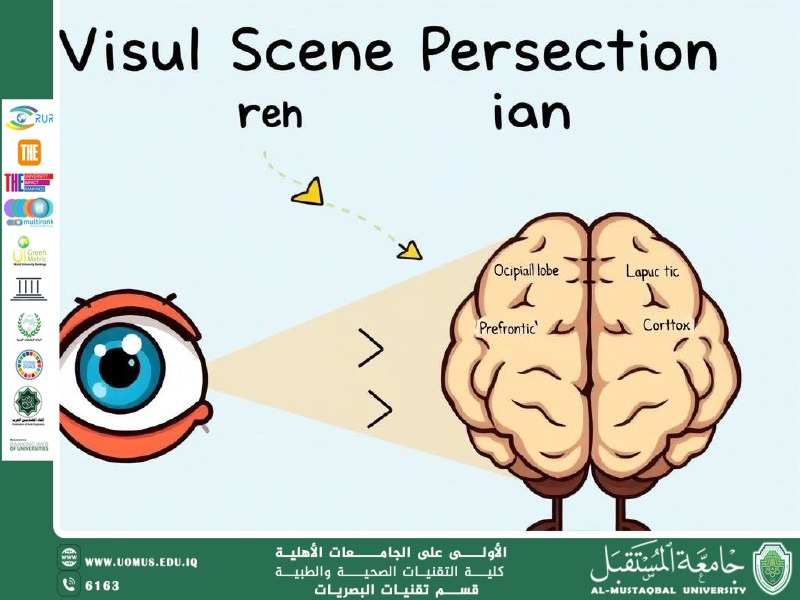
"Scientific Article by Ms. Haneen Haider Hussein: “Visual Interpretation in the Brain: From Light Reception to Meaning Formation
How does visual interpretation occur in the brain?
The process goes through several interconnected stages:
1. Capturing Light in the Eye
The retina receives light and converts it into electrical signals, serving as the primary input for the brain’s visual processing.
2. Transmitting Signals to the Brain
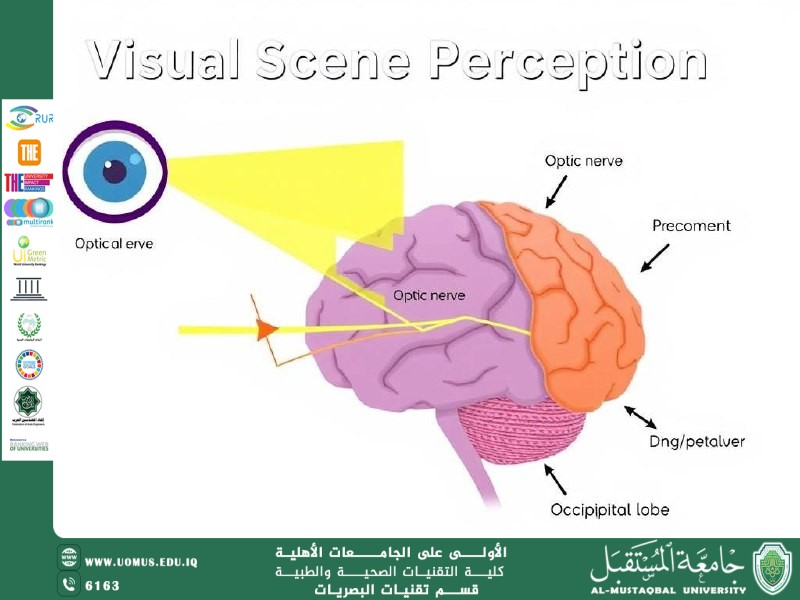
The signals travel through the optic nerve to specialized centers in the brain, where initial analysis begins.
3. Initial Processing in the Visual Cortex
Located in the occipital lobe (at the back of the brain), the visual cortex performs early-stage analysis, including:
Edge detection
Orientation determination
Light and dark differentiation
Color and motion analysis
4. Interpreting Meaning in Higher Brain Areas
After initial processing, the information is transmitted to advanced pathways:
🔹 Ventral Pathway (What Pathway)
Determines what the object is
Recognizes faces, words, and objects
🔹 Dorsal Pathway (Where/How Pathway)
Determines the object’s location and how to interact with it
Estimates depth, distance, and motion
5. Formation of Conscious Perception
The brain integrates visual information with:
Memory
Past experiences
Attention
Expectations
As a result, we perceive a coherent visual scene with meaningful content.
Al-Mustaqbal University – First among Private Universities