.The Circular Shape and Its Relationship with Design.By Teaching Assistant Mousa Diaa*
The circular shape is one of the most prevalent geometric forms in human history and holds a central position in design sciences due to its distinctive visual, psychological, and functional properties. A circle, being a shape without angles and having a fixed center equidistant from all points on its circumference, carries symbolic connotations related to harmony, balance, and perfection. This has led to its application across various design fields, from graphic design to industrial design and architecture.
This article aims to examine the circular shape in terms of its aesthetic and symbolic properties, analyze its role in generating effective design solutions, and explain the reason for its continued presence in contemporary design practices.
1. Visual Properties of the Circle
The circle has a unique ability to create a sense of continuity and gentle movement. Its most notable visual characteristics include:
1.1 Consistency and Harmony
The absence of sharp angles gives the circle visual consistency, making it softer compared to other shapes. This enables it to create balance within a design composition, even when used in small proportions.
1.2 Visual Focus
The circle naturally attracts the eye, acting as a focal point. Many brands exploit this characteristic by designing circular logos or incorporating circular elements to generate quick visual engagement.
1.3 Suggestion of Movement
Despite its static form, the circle conveys a sense of rotational motion, making it ideal for designs that require an impression of dynamism or temporal continuity.
2. Symbolic and Psychological Significance of the Circle
The circular shape is deeply associated with cultural and anthropological meanings:
2.1 Perfection and Unity
Historically, the circle has been linked to the ideas of infinity and perfection, as it has no beginning or end. This makes it suitable for designs aiming to convey messages of unity or wholeness.
2.2 Safety and Enclosure
The human brain tends to interpret curves as less threatening than sharp shapes. For this reason, circles are used in products intended for children or in digital applications designed to create a comfortable and friendly user experience.
2.3 Spirituality and Rituals
Circles appear in many spiritual rituals and symbols, such as worship circles and philosophical icons. This is reflected in the design of meditative spaces or logos with spiritual dimensions.
3. Application of the Circular Shape in Contemporary Design
3.1 Graphic Design
Circles are widely used in logo design, digital icons, and infographics. Social media platforms prefer circular profile pictures for their suggestion of friendliness and openness.
3.2 Industrial Design
Everyday products such as watches, plates, and control devices often utilize circular shapes to enhance usability and reduce perceptions of harshness or rigidity.
3.3 Architecture and Interior Design
Circles are applied in ceiling designs, windows, and movement pathways to create fluidity within spaces. Continuous circular areas also guide human movement smoothly.
3.4 Digital User Interfaces (UI/UX)
Circles have become central in designing buttons and touch interfaces, especially with smart screens that rely on circular touchpoints as primary interactive areas.
4. The Circle as a Tool for Creative Design
The circular shape provides designers with extensive experimentation opportunities, such as:
Integrating circles with other shapes to create balance in compositions.
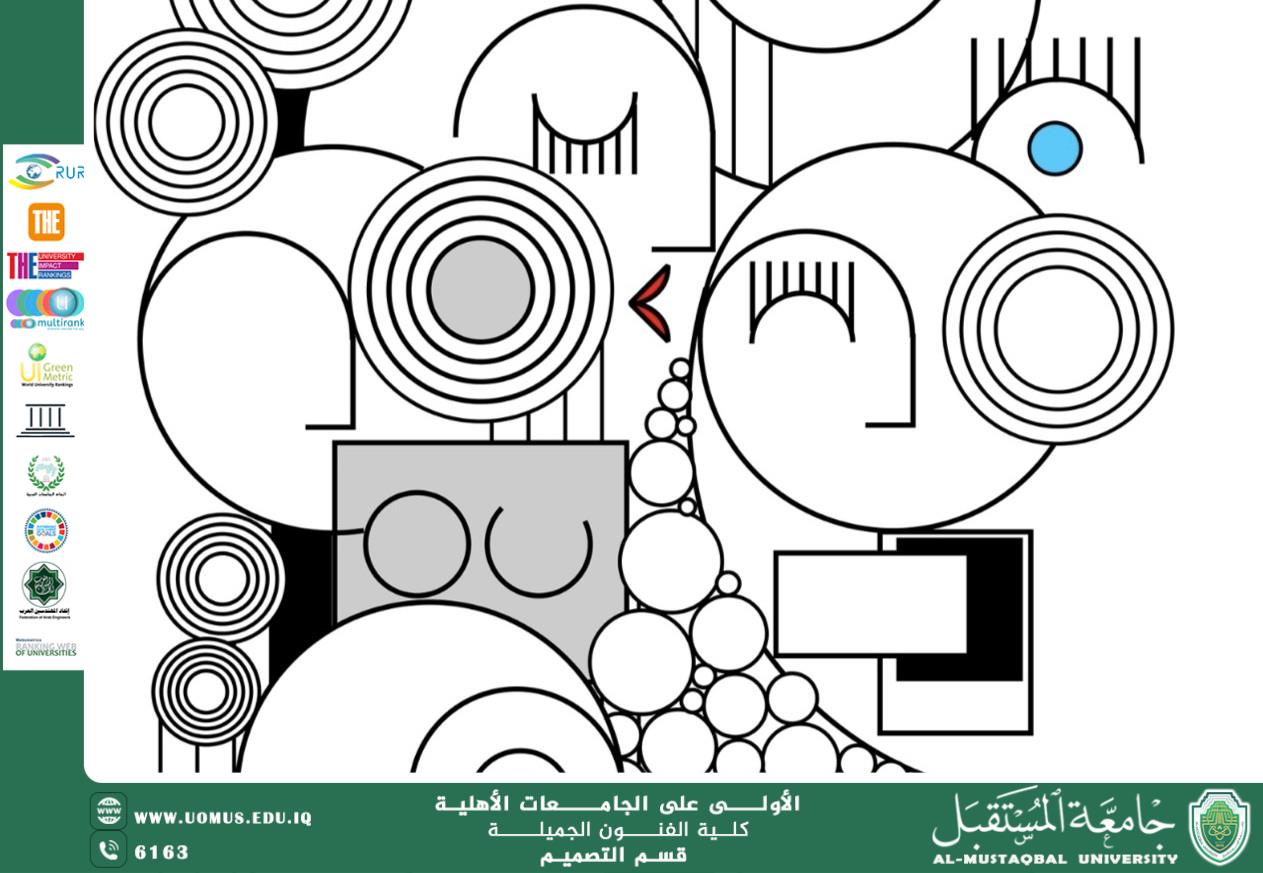
Repeating circles to generate patterns with strong visual impact.
Breaking the circular form to obtain new shapes that convey modernity and abstraction.
The simplicity of the shape also allows designers to use it as a foundation for complex compositions without losing overall harmony.
Conclusion
The circular shape maintains a constant presence in design, not only because of its geometric simplicity but also due to its symbolic, aesthetic, and psychological meanings. It has proven effective in enhancing visual clarity and creating a sense of perfection and harmony within compositions. The circle will continue to be a fundamental element in design thanks to its adaptability to various artistic styles and modern technological techniques.
Almustaqbal University, The First University in Iraq