A Scientific Article by Instructor Dr. Karrar Majeed Obeid, titled: The Sustainable Society: Concept, Dimensions, and Challenges of Its Realization
Abstract
The concept of a sustainable society is a modern paradigm that has emerged in response to the environmental, economic, and social challenges facing the contemporary world. This concept aims to achieve a balance between meeting the needs of the present generation without compromising the ability of future generations to meet their own needs. This article discusses the concept of a sustainable society, its core dimensions, its importance, as well as the challenges facing its implementation and ways to enhance its sustainability.
1. Introduction
With the continuous increase in population and rapid industrial and technological development, numerous problems have emerged, such as environmental pollution, depletion of natural resources, poverty, and social injustice. Hence, the concept of a sustainable society has emerged as a strategic solution aimed at building societies capable of enduring and developing without harming the environment or humanity.
2. Concept of a Sustainable Society
A sustainable society is one that uses its natural and human resources efficiently, achieves economic development while preserving the environment, and ensures social justice and equality among its members. This society is based on long-term planning, rational resource management, and the promotion of environmental and cultural awareness.
3. Dimensions of a Sustainable Society
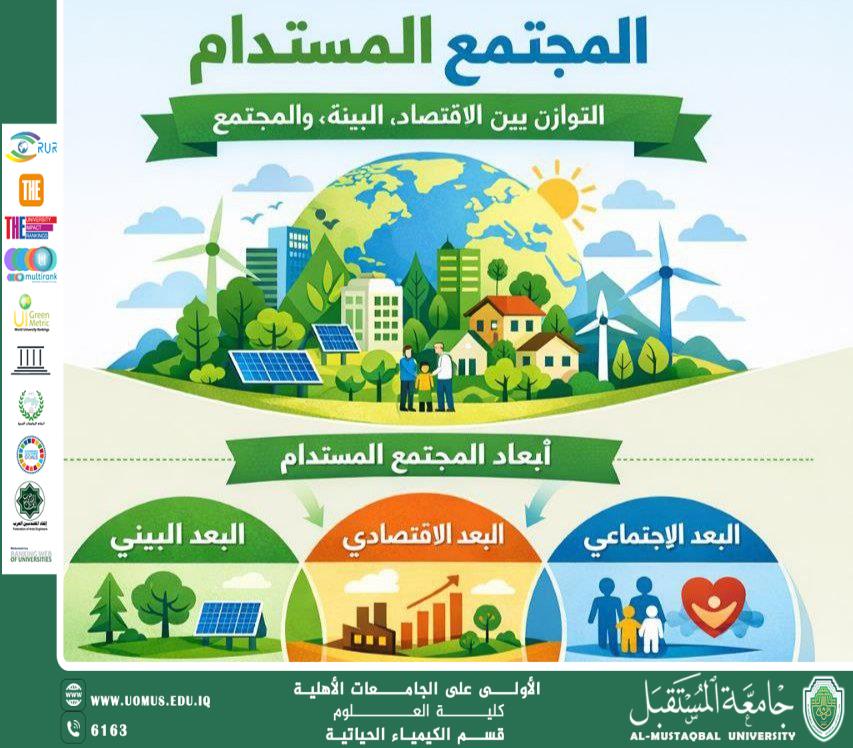
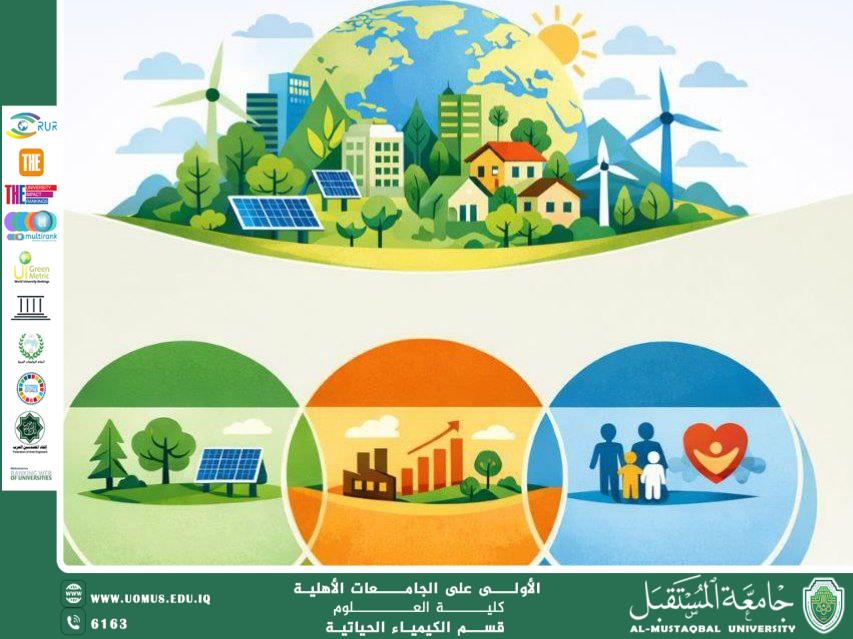
A sustainable society relies on three main, interconnected dimensions:
3.1 Environmental Dimension
Focuses on protecting the environment,reducing pollution, preserving biodiversity, the rational use of natural resources, and reliance on renewable energy sources such as solar and wind power.
3.2 Economic Dimension
Aims to achieve sustainable economic growth by supporting the green economy,providing job opportunities, encouraging innovation, reducing the gap between social classes, while ensuring efficient resource use.
3.3 Social Dimension
Concerned with achieving social justice,providing education and healthcare, promoting community participation, ensuring human rights, and building a cohesive society based on cooperation and solidarity.
4. Importance of a Sustainable Society
The importance of a sustainable society lies in:
· Preserving natural resources for future generations.
· Improving quality of life and public health.
· Reducing poverty and unemployment.
· Enhancing social and economic stability.
· Confronting climate change and mitigating its negative effects.
5. Challenges to Achieving a Sustainable Society
Despite its importance, several challenges hinder its realization, most notably:
· Weak environmental awareness among individuals.
· Excessive reliance on fossil fuels.
· Lack of effective environmental legislation.
· Economic challenges and insufficient funding.
· Resistance to change in some societies.
6. Ways to Promote a Sustainable Society
To achieve a sustainable society, it is necessary to:
· Disseminate environmental awareness through education and media.
· Support scientific research and clean technology.
· Enact laws and regulations that protect the environment.
· Encourage the use of renewable energy.
· Foster partnerships between the government, the private sector, and civil society.
7. Conclusion
The sustainable society represents an imperative necessity to confront current global challenges, not merely an option. Its achievement requires joint cooperation among individuals, institutions, and governments, in addition to adopting long-term policies that balance economic development, environmental preservation, and social justice, to ensure a secure and stable future for generations to come.
---
University of Al-Mustaqbal Ranks First Among Iraqi Private Universities