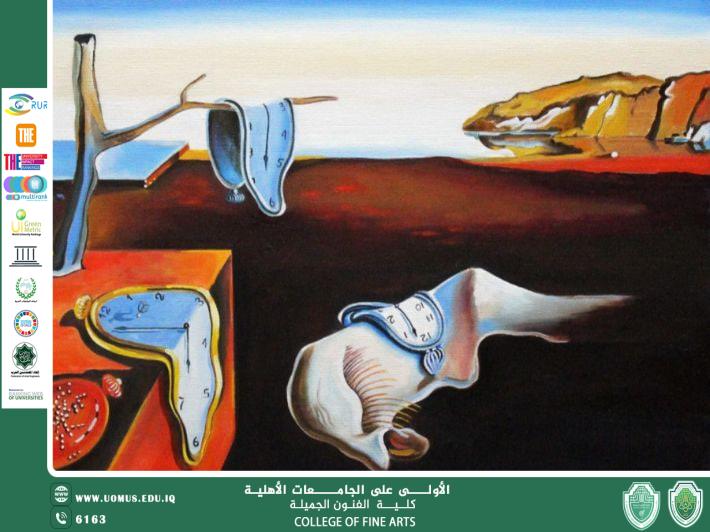
An Article "Surrealism and Psychoanalysis: Exploring the Depths of the Unconscious Mind "By: Assistant Professor Dr. Ali Atiya Al-Saadi Scientific Associate of the College of Fine Arts
29/04/2025 Share :
Surrealism stands as one of the most influential art movements that delved into the depths of the human psyche, transcending the superficial reality to explore the unconscious mind. Officially established in 1924 by French poet André Breton, Surrealism was heavily influenced by Sigmund Freud's theories on the unconscious and dream interpretation. Artists like Salvador Dalí, Max Ernst, and René Magritte embraced these concepts to create artworks that reflect dreams, obsessions, and repressed desires.<br /><br />Surrealists employed techniques such as "automatic writing" and free association, allowing thoughts to flow without conscious control, thus expressing unconscious content. In painting, these techniques manifested through dreamlike imagery and enigmatic symbols representing internal conflicts and deep-seated emotions. They also viewed psychological states like hysteria and psychosis as sources of artistic inspiration, believing that these conditions reveal hidden aspects of the human psyche.<br /><br />Surrealism significantly contributed to our understanding of the intersection between art and psychoanalysis, demonstrating that artistic creativity can serve as a means of self-exploration and expression of internal experiences. By integrating psychoanalytic concepts into artistic practices, Surrealists opened new avenues for artistic expression beyond traditional constraints, establishing themselves as pioneers in modern art.<br /><br />Al-Mustaqbal University the first university of Iraq .