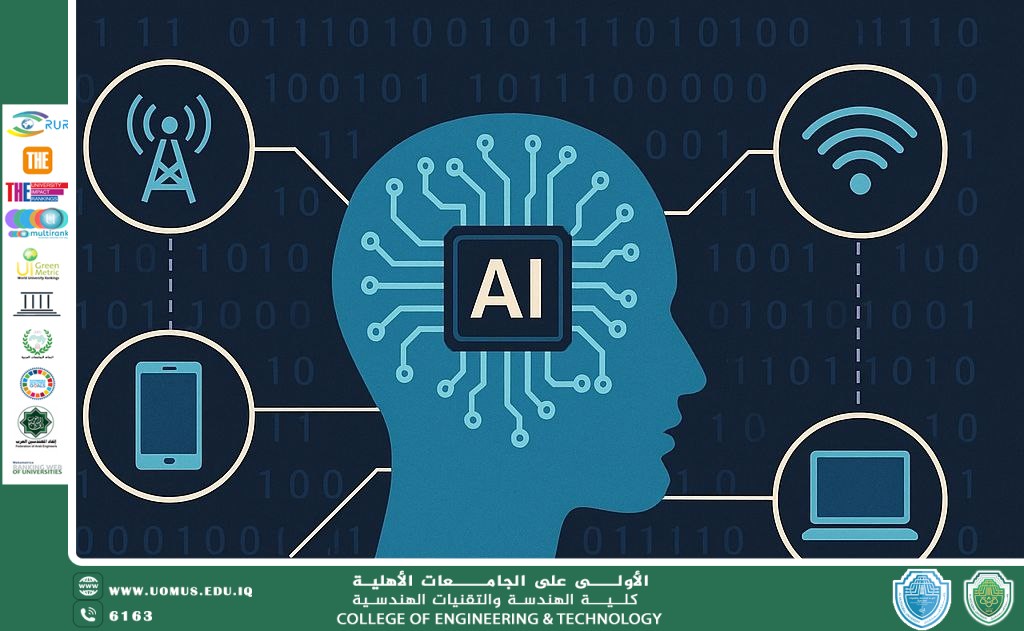
Article :Designing Intelligent Communication Networks Using Artificial Intelligence Techniques
18/06/2025 Share :
Communication networks have evolved significantly to cope with the increasing volume of data and the complexity of applications. The design of intelligent networks relies on artificial intelligence (AI) techniques to improve efficiency, self-management, and flexibility in networks.<br />Intelligent networks use machine learning and deep learning algorithms to analyze traffic data, predict faults, and dynamically manage resources. Technologies such as Software-Defined Networking (SDN) combined with AI are employed to achieve intelligent control over data flow and enhance Quality of Service (QoS).<br />These networks face challenges related to computational complexity, security, and privacy protection. Nevertheless, intelligent networks are the foundation for supporting future applications like the Internet of Things (IoT) and sixth-generation communication networks (6G).<br />Daily Uses of Intelligent Communication Networks and Artificial Intelligence<br />AI-powered intelligent networks play an increasingly important role in our daily lives by improving connection quality and speeding up data transfer across various devices such as smartphones, computers, and smart home devices.<br />These networks support live streaming services, augmented reality applications, and digital personal assistant systems like voice assistants. They also contribute to enhancing data security through automatic detection of cyber threats and prevention of breaches.<br />Furthermore, intelligent transportation systems, smart cities, and the Internet of Things (IoT) fundamentally depend on intelligent communication networks to coordinate devices and analyze data in real-time, improving energy efficiency, traffic management, and providing remote healthcare services.<br />Eng. Elaf Abdul-Ali Maktoof Al-Jubouri