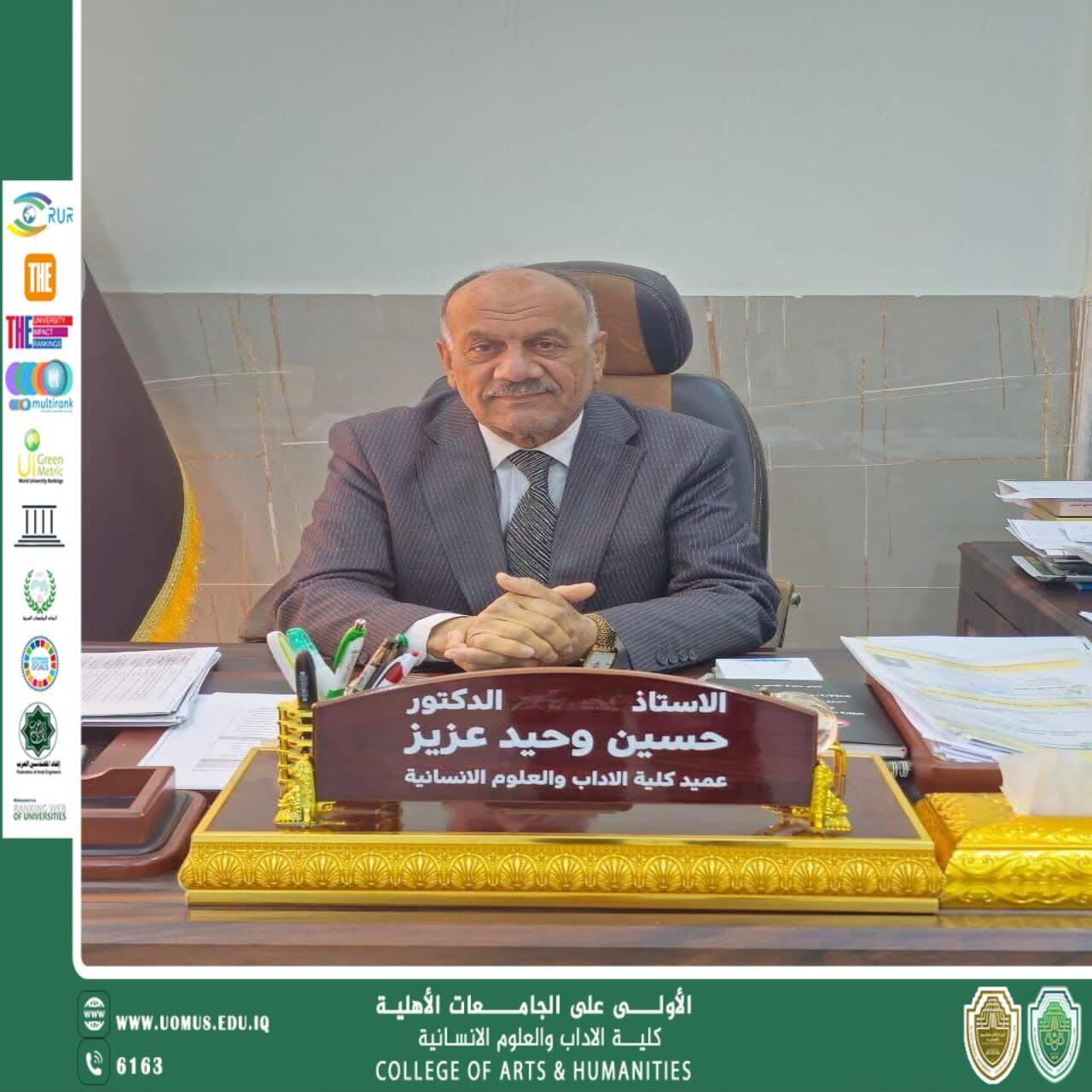
Dean of the Faculty of Arts writes an article entitled "Lifelong Learning for Building Inclusive Societies."
01/11/2025 Share :
Dean of the College of Arts at al mustaqbal University Publishes Thought Piece on Lifelong Learning
The Dean of the College of Arts at Future University, Professor Dr. Hussain Waheed Aziz, published a new thought piece titled "Lifelong Learning for Building Inclusive Societies," as part of the College's commitment to enhancing academic awareness and establishing a culture of sustainability within the university environment.
In his article, the Dean addressed the importance of the concept of lifelong learning as a core pillar of sustainable development, explaining that modern societies no longer rely solely on traditional education, but on continuous learning that grants individuals the ability to acquire new skills and keep pace with scientific and technological transformations.
Thought Piece: Lifelong Learning for Building Inclusive Societies
The concept of lifelong learning has been gaining increasing importance in recent decades. Unlike traditional education, which is often confined to childhood and youth, lifelong learning focuses on the continuous pursuit of knowledge and skills throughout a person's life. This approach not only benefits individuals but also strengthens communities and nations. Specifically, lifelong learning is essential for building inclusive societies that allow every individual the opportunity to participate, contribute, and flourish.
An inclusive society is one that values diversity, respects differences, and ensures equal opportunities for all its members. Herein lies the role of lifelong learning as a powerful tool for achieving this vision, as it allows people to keep pace with social, economic, and technological changes. In a rapidly changing world, education cannot stop at graduation. Instead, individuals must have opportunities to reskill or upskill in line with new developments.
The importance of lifelong learning lies in its ability to reduce inequalities. Many who did not have the opportunity for formal education early in life can develop their skills and acquire knowledge through continuous learning programs. This gives marginalized groups a chance to integrate more deeply into society. For example, adult literacy programs enable individuals to secure jobs, participate in civic life, and improve their living conditions.
Furthermore, lifelong learning fosters social cohesion. When individuals from diverse backgrounds engage in shared learning experiences, they develop mutual understanding and respect. This process builds bridges between communities, reduces prejudice, and supports peace. Thus, education becomes a unifying force that helps societies overcome divisions related to race, religion, or social class.
Another critical aspect is the role of continuous learning in the labor market. Modern economies are constantly evolving due to globalization and technological advancement. Today's jobs may disappear tomorrow, replaced by entirely new professions. Without continuous learning, workers face the risk of marginalization. Conversely, societies that invest in lifelong learning create a flexible workforce capable of adapting to the demands of the future. This not only boosts economic growth but also ensures that all individuals benefit from progress.
al mustaqbal University: First Among Private Universities