
Scientific Article by Lecturer Haider Mutlaq Musa Title: Applications of Analytical Chemistry in Air Pollution Analysis
Introduction
Analytical chemistry is one of the fundamental branches of chemical sciences, playing a vital role in environmental studies, especially air pollution analysis. It focuses on identifying and quantifying pollutants present in the atmosphere, helping to assess air quality and evaluate their effects on human health and the environment.
Principle of Chemical Analysis
Air pollution analysis is based on measuring physical or chemical changes that occur when pollutants interact with light, reagents, or sensors. These changes are measured at specific wavelengths or signal responses and converted into numerical values to determine pollutant concentrations accurately.
Components of Chemical Analysis
1. Analytical Instruments
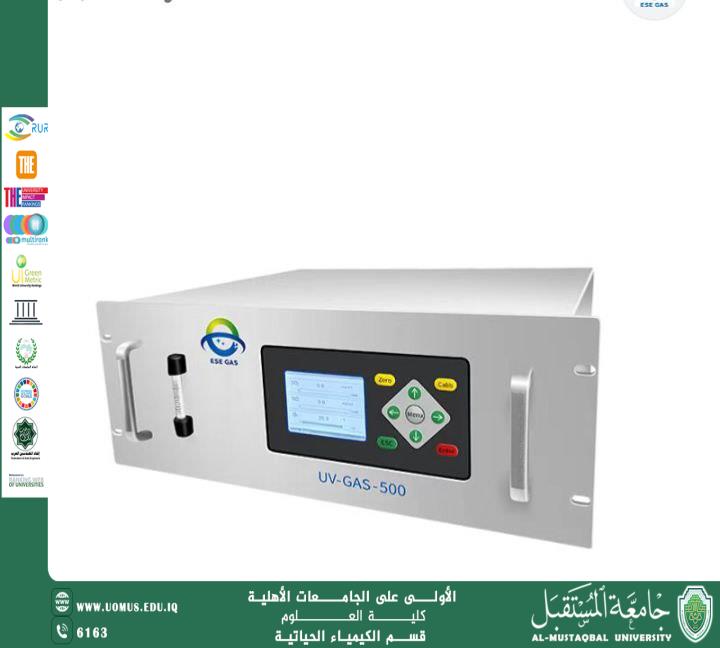
Air pollution studies involve analytical instruments such as UV–Vis spectrophotometers, infrared (IR) analyzers, gas chromatography (GC), and particulate matter analyzers.
2. Samples
Air samples are collected from urban, industrial, or indoor environments and prepared for analysis using suitable techniques to ensure accurate results.
3. Reagents and Standards
Standard gases and reference materials are used for instrument calibration and validation of analytical measurements.
Types of Analysis
1. Qualitative Analysis
Used to identify the types of air pollutants such as sulfur dioxide, nitrogen oxides, and carbon monoxide.
2. Quantitative Analysis
Aimed at measuring pollutant concentrations and determining air pollution levels.
3. Trace Analysis
Focused on detecting pollutants present at very low concentrations that may pose serious health risks.
Practical Examples
Measurement of ozone using UV–Vis spectroscopy.
Analysis of carbon monoxide using infrared spectroscopy.
Determination of particulate matter using gravimetric methods.
Advantages
Analytical chemistry techniques offer high accuracy, good sensitivity, and the ability to monitor air pollutants continuously.
Limitations
These methods require advanced instrumentation, high operational costs, frequent calibration, and results may be affected by environmental conditions.
Conclusion
Analytical chemistry plays a crucial role in air pollution monitoring and environmental protection. It provides reliable data that support effective decision-making to reduce pollution and protect public health.
Al-Mustaqbal University
Ranked First among Private Iraqi Universities