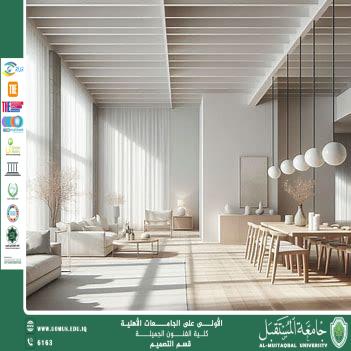
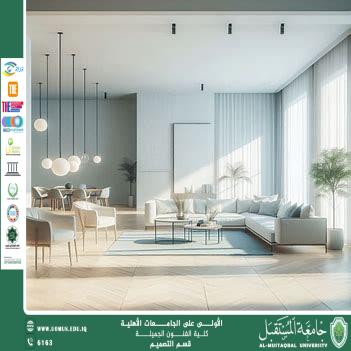
Fluidity and Its Aesthetic Representations in Contemporary Interior Spaces
Fluidity is considered one of the key contemporary design concepts that has gained increasing importance in interior design due to its direct impact on shaping architectural spaces and enhancing their aesthetic and functional values. Fluidity refers to the smooth visual and spatial flow between interior elements, achieving harmony while reducing visual and functional barriers.
The application of fluidity in contemporary interior spaces contributes to creating more comfortable and flexible environments. It relies on soft lines, curved forms, and gradual transitions between spaces rather than sharp divisions and rigid compositions. This approach enhances the sense of continuity and connection, providing users with a more balanced and calm spatial experience.
The aesthetic representations of fluidity appear through the use of harmonious color schemes, indirect lighting, and the thoughtful integration of materials and finishes. These elements strengthen the visual identity of interior spaces and play a significant role in guiding user movement and organizing circulation paths in alignment with each space’s function.
From a psychological perspective, fluidity positively influences users’ perception of space by reducing feelings of congestion and stress while enhancing openness and visual comfort. Therefore, it is a fundamental element in designing residential, educational, healthcare, and cultural spaces, where human-centered design is essential for success.
Fluidity in contemporary interior design is closely linked to sustainability through efficient space utilization, enhanced natural lighting and ventilation, and reduced reliance on unnecessary partitions. This aligns with Sustainable Development Goal 11: “Sustainable Cities and Communities”, which aims to create resilient, healthy, and inclusive urban environments.
In conclusion, fluidity represents a key factor in the success of contemporary interior spaces, achieving a balance between aesthetics, functionality, and sustainability, and contributing to the creation of more human-centered and interactive architectural environments.
Almustaqbal University, The First University in Iraq.
الهدف 11 – المدن و المجتمعات المستدامة