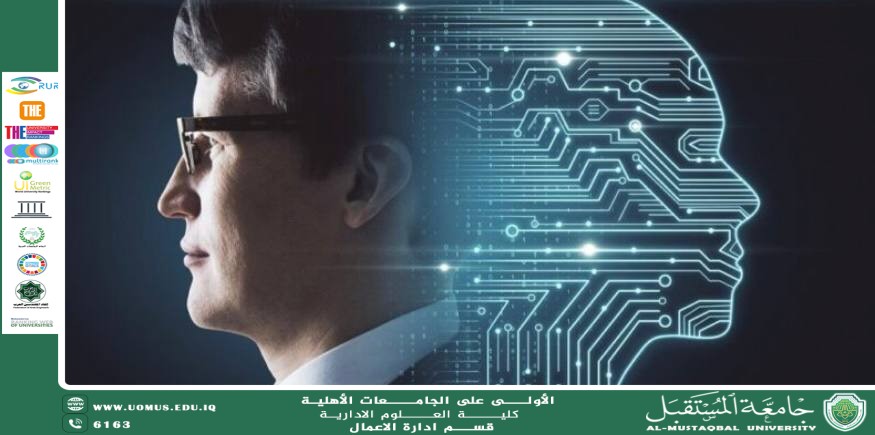

Artificial Intelligence and Its Role in Administrative Decision-Making
Prepared by Dr. Khalid Hussein Ali Al-Marzouk
The rapid development of Artificial Intelligence (AI) technologies has led to fundamental transformations across various fields of life, particularly in decision-making. Governmental and private institutions have increasingly relied on intelligent systems to analyze big data, predict future outcomes, and support decision-makers with accurate and timely information. Today, artificial intelligence is regarded as a strategic tool that enhances the efficiency and quality of decisions while reducing reliance on personal judgment and non-scientific intuition.
Concept of Artificial Intelligence
Artificial intelligence is defined as a branch of computer science that aims to design systems and software capable of simulating human cognitive abilities such as learning, reasoning, problem-solving, and decision-making. AI relies on multiple technologies, most notably:
• Machine Learning (ML)
• Artificial Neural Networks
• Natural Language Processing (NLP)
• Big Data Analytics
Concept of Decision-Making
Decision-making is an organized and rational process aimed at selecting the best alternative from a set of available options, based on specific criteria and accurate information. This process includes several key stages:
• Problem Identification
• Information and Data Collection
• Analysis of Alternatives
• Selection of the Optimal Alternative
• Decision Implementation
• Evaluation of Results
The Role of Artificial Intelligence in Supporting Decision-Making
Artificial intelligence contributes to decision-making through several mechanisms, including:
Big Data Analysis
AI can process vast amounts of data with speed and accuracy beyond human capabilities, helping to uncover patterns and hidden relationships that support scientifically grounded decisions.
Prediction of Future Outcomes
Intelligent algorithms use predictive models to forecast future scenarios, such as market demand, economic risks, or health crises.
Reducing Human Bias
AI minimizes the influence of psychological and emotional factors that may negatively affect human decisions, provided that the data used is neutral and free from bias.
Speed of Response and Decision Accuracy
In environments requiring immediate decisions—such as security, healthcare, and disaster management—AI provides real-time solutions based on instant data analysis.
Fields of AI Application in Decision-Making
• Government Sector: Supporting public policies, economic planning, and resource management.
• Healthcare Sector: Disease diagnosis, treatment selection, and hospital management.
• Economic and Financial Sector: Risk assessment, investment decisions, and fraud detection.
• Education: Decision-making related to curricula and evaluation of educational performance.
Challenges and Limitations
Despite the significant advantages of artificial intelligence in decision-making, several important challenges remain, including:
• Overreliance on intelligent systems
• Lack of transparency in some algorithms (the “black box” issue)
• Risks of algorithmic bias
• Ethical and legal issues related to accountability