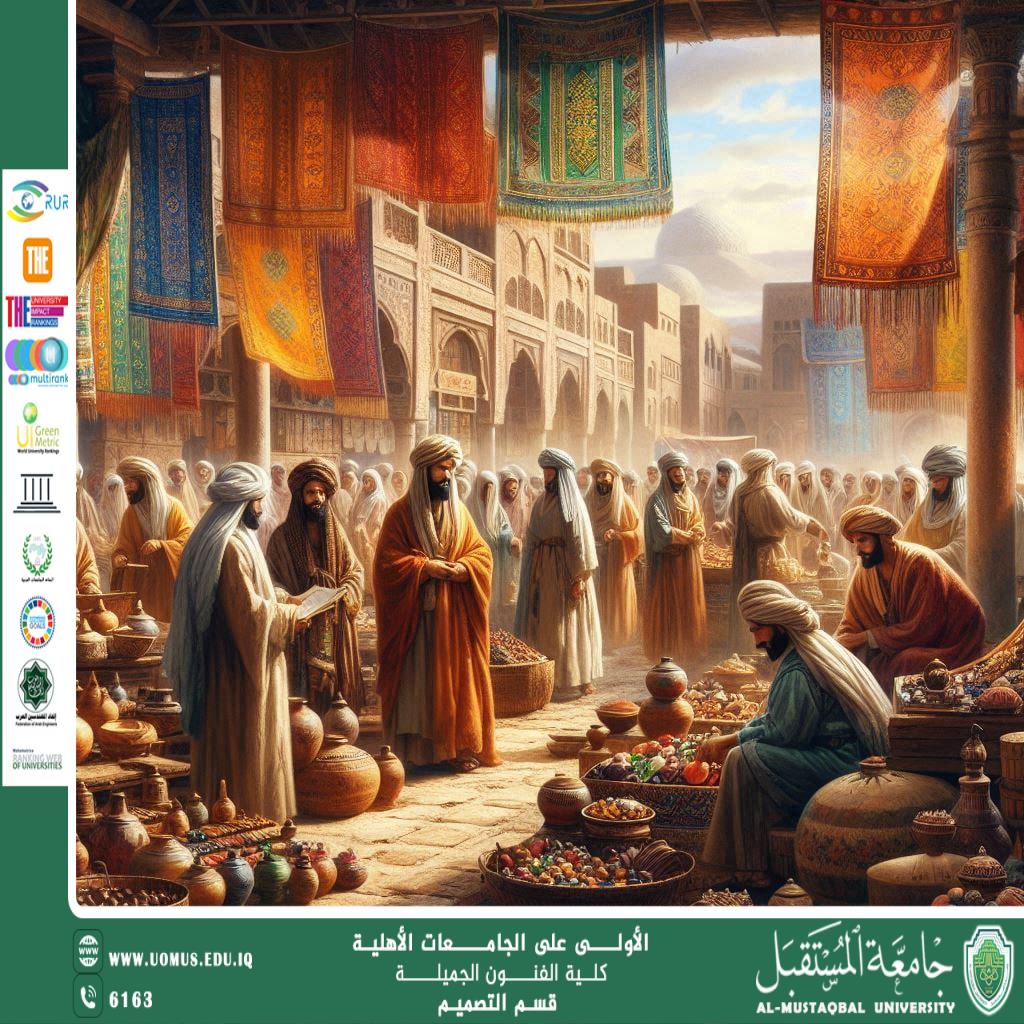
An Article "The Concept of Time Before Islam (Part Two)" By Assistant Teacher Dr. Majid Hamid Hassoun
Since the nomadic lifestyle prevailed over settlement in Arab society, it significantly influenced their overall perception of life. The vast and harsh desert environment, with its limitless expanse, shaped their understanding of time, making it more intuitive and approximative rather than a precisely measured entity. The dominance of the desert, acting as an overwhelming force, positioned humans as part of its vastness rather than as central figures exerting control. This spatial dominance reflected on their perception of time, creating a spiritual balance between the boundless nature of space and the supremacy of time.<br /><br />As recorded in "Lisan al-Arab", Arabs would often curse and blame time (al-Dahr) during misfortunes, such as death or aging, saying: "They were struck by the blows of time and its disasters, and time wiped them out." They attributed these occurrences to time, personifying it as an active force. The destructive nature of time is also mentioned in the Holy Quran:<br /><br />"And they say, 'There is nothing but our worldly life; we die and live, and nothing destroys us except time (al-Dahr).'" (Al-Jathiya – Verse 24).<br /><br />In "Al-Milal wa al-Nihal", Al-Shahrastani refers to this group as "Mu'attilat al-Arab" (The Arab Nihilists), who denied creation, resurrection, and the afterlife, believing in natural causation and the annihilating force of time.<br /><br />Pre-Islamic Arabic poetry also reflects this concept. Poet ‘Umar ibn Abi Rabi’ah illustrates the relentless power of time in his verse:<br /><br />"The daughters of time struck me from where I did not expect,<br />So how can one defend against a strike when he is not a striker?<br />Time destroyed what it destroyed in a single night,<br />Yet it did not undo what I had woven with order.<br />Hope for a day and a night exhausted me,<br />Then the hope for a year, and another year after that."<br /><br />This indicates that time (al-Dahr) was not perceived as an infinite or absolute entity but rather as durations that could be long or short. Time was seen as a force governing human existence, with people attributing their demise to it. Time was thus linked to events rather than being an independent entity separate from human actions.<br /><br />Beyond this external perception, time also manifested as an internal psychological force, pressing upon individuals. This is evident in poetry that describes how suffering distorts the perception of time, as in the following lines:<br /><br />"A night, like the waves of the sea, let down its darkness,<br />Covering me with countless sorrows to test me.<br />So I said to it when it stretched out its back,<br />And burdened me with its weight:<br />O long night, will you not end<br />With dawn? Yet the dawn is no better than you!<br />O what a night! Its stars<br />Were tied in knots, fixed like spears in the sky."<br /><br />This imagery illustrates how time’s weight is felt through a spatial metaphor, intertwining temporal and physical dimensions. Furthermore, in pre-Islamic poetry, time often served as a vessel for memory, as poets would begin their odes by recalling past moments at abandoned campsites. This is exemplified in Imru’ al-Qais’ famous line:<br /><br />"Stop, let us weep for the memory of a beloved and her dwelling,<br />At the bend of al-Liwa, between al-Dukhul and Hawmal."<br /><br />Such verses reflect the deep spiritual connection between Arabs and their desert landscape, emphasizing the interwoven relationship between time and space. This link is evident in Arabic linguistic expressions, where verbs denoting time are often tied to place, such as "azmana fi al-makan" (to spend time in a place) or "ahāna fi al-makan" (to dwell in a place for a period). The Arab perception of time was dynamic, defined by movement, change, and events rather than a fixed, absolute continuum.<br /><br />Contribution to Quality Education (Sustainable Development Goal 4):<br />This article aligns with Goal 4 of the United Nations' Sustainable Development Goals (Quality Education) by:<br /><br />Enhancing cultural and historical understanding: It explores how the environment shaped Arab perceptions of time, contributing to a deeper understanding of human intellectual evolution.<br />Preserving intellectual heritage: It documents and disseminates Arab conceptions of time, reinforcing cultural identity and safeguarding historical knowledge.<br />Promoting academic research: It encourages analytical study in linguistics, history, and literature, supporting higher education and historical inquiry.<br />By examining how Arab culture conceptualized time, the article underscores the role of education in preserving and interpreting historical knowledge, ensuring its sustainability for future generations.<br /><br />Almustaqbal university , The number one university in Iraq