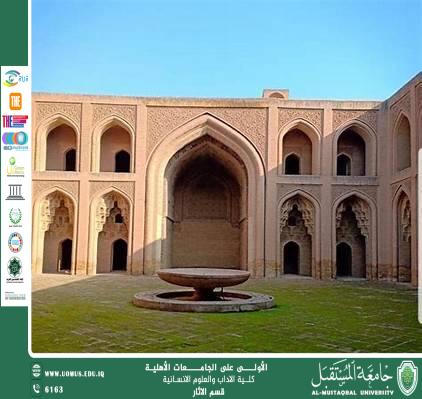

Dr. Fawzia Mahdi Al-Maliki, Head of the Department of Archaeology, writes an article titled "The Abbasid Palace."
The Abbasid Palace<br />(This article is presented within the framework of Sustainable Development Goal 4: Quality Education)<br /><br />The Abbasid Palace, one of Iraq’s venerable historical landmarks, is located in the heart of Baghdad and stands as a prominent example of refined Islamic architecture. The palace’s main gate is distinguished by its unique design and linear decorations executed by skilled sculptors, opening onto an elegant corridor that leads to a spacious, nearly rectangular courtyard (approximately 21.5 meters on one side and 20 meters on the other). This courtyard is surrounded by iwans that form a distinctive architectural ensemble; the iwan’s ceiling features an ornate oval design, with decorative elements beginning at a height of about 3.5 meters and extending along the upper walls to reach the two smaller niches that crown the lateral arches at either end of the iwan.<br /><br />The palace’s decoration was carried out using baked or fire-hardened brick, employing carving and embellishment techniques that imparted a unique character to its walls and ceilings. This fusion of geometric and floral motifs, along with designs reminiscent of carpets, honeycomb patterns, and carved stones, distinguishes the decorative elements of the Abbasid Palace from other landmarks in Baghdad.<br /><br />Opinions differ regarding the function of this monument; some researchers believe it was designated for the Caliph Nasser ad-Din Allah, while others argue that it functioned as a school, citing the significant resemblance between the design of the palace and that of the famous Mustansiriya and Marjani schools in Baghdad. Dr. Naji Ma'ruf, Head of the History Department at the University of Baghdad in the 1950s, supported this view, whereas the late scholar Mustafa Jawad maintained that the palace dates back to the reign of Caliph Nasser ad-Din Allah, citing accounts from travelers such as Ibn Jubayr, who described entering the palace through a corridor draped in coarse fabric adorned with colorful designs and perfumed with musk and saffron.<br /><br />Despite suffering damage over the centuries due to the Tatar invasions and the passage of time, the General Directorate of Antiquities initiated the first restoration campaign in 1938 to repair the northern and eastern sections and the affected rooms. Later, parts of the palace were vandalized during the events following the fall of the regime in 2003, leading to the theft of the external doors, which were subsequently reinstalled based on the original blueprints.<br /><br />The iwan’s space in the Abbasid Palace is the largest of its kind, with its ceiling resting on two walls separated by a distance of five meters. The large courtyard is encircled by corridors and passageways; one such passage is 26.70 meters long, 1.28 meters wide, and 9.20 meters high. The palace consists of five main halls in addition to 16 rooms along the eastern side and 18 rooms along the western side, along with several smaller rooms, bringing the total number of rooms to over forty, not including the halls and other facilities.<br /><br />Researchers consider the decorative motifs of the Abbasid Palace to be unparalleled in Baghdad, as they combine diverse geometric and floral patterns with designs inspired by carpets, as well as carvings that resemble honeycombs and chiseled stones, thereby endowing the palace with a unique and distinctive character in the realm of Islamic architecture.<br /><br />Al‑Mustaqbal University – The Premier University in Iraq.